
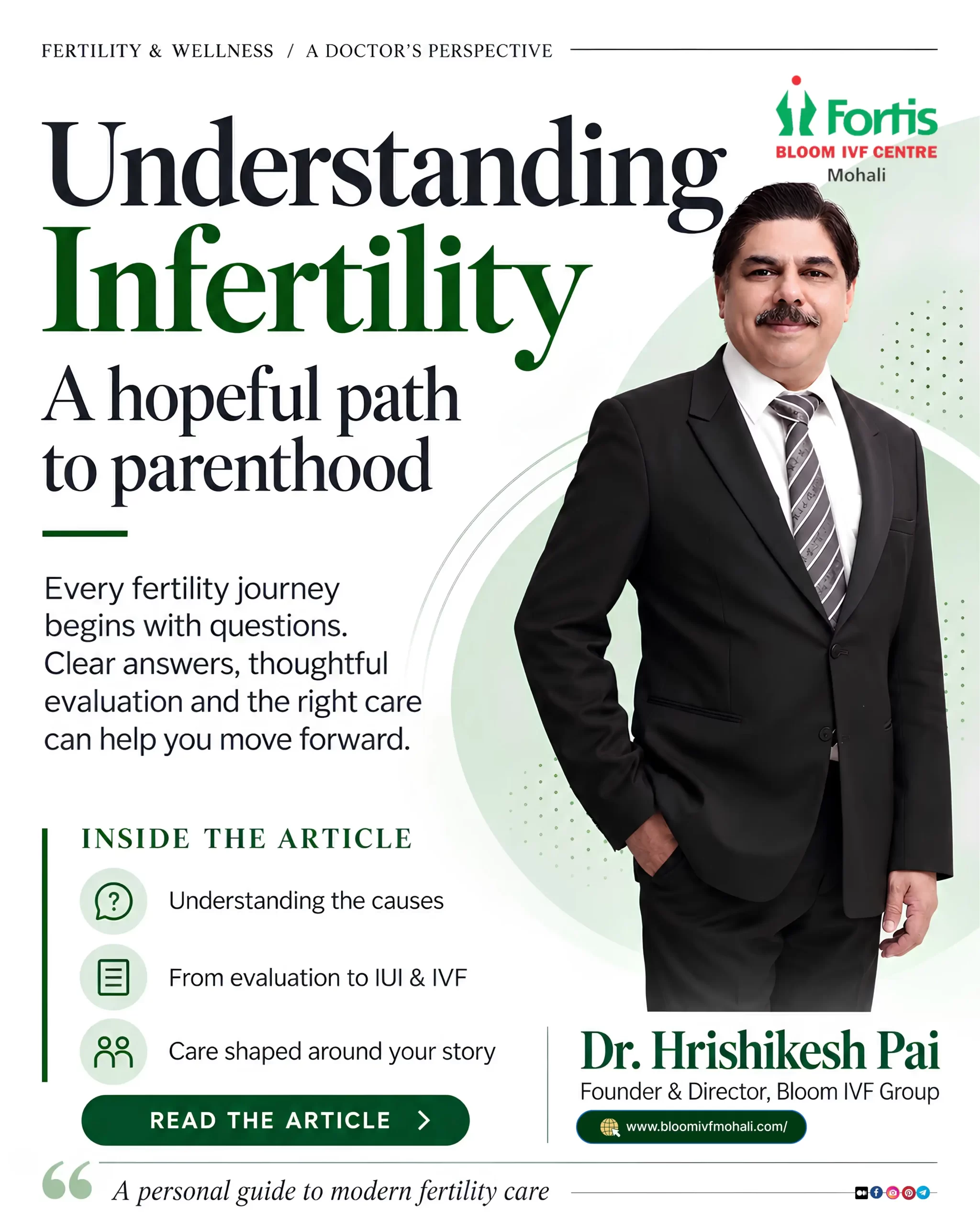
By Dr. Hrishikesh Pai
(MD, FCPS, FICOG, MSc in Clinical Embryology (USA), Clinical Fellow in Reproductive Biology (Australia), Past President of FOGSI & ISAR, Founder & Director of Bloom IVF Group)
Introduction: A Personal Word to Every Hopeful Parent
Over my four decades in reproductive medicine, I have sat across from thousands of couples in my consultation rooms at Lilavati Hospital in Mumbai, Fortis Hospitals in Delhi NCR, DY Patil in Navi Mumbai, and Bloom IVF centres across India. Each couple brings a unique story, but almost all share a similar emotional burden—anxiety, uncertainty, self-doubt, and the overwhelming weight of unanswered questions.
When a couple finds it difficult to conceive naturally, society often surrounds them with unsolicited advice, misconceptions, or silence. My goal in writing this comprehensive guide is simple: to replace fear with scientific clarity, emotional warmth, and actionable medical guidance.
Infertility is not a dead end. It is a biological hurdle that modern science, paired with compassionate clinical care, can almost always overcome.
1. What is Infertility? Breaking the Stigma
In medical terms, infertility is defined as the inability to achieve a clinical pregnancy after 12 months or more of regular, unprotected sexual intercourse (or after 6 months if the woman is over 35 years of age).
For generations, fertility challenges were mistakenly viewed as solely a female health concern. Today, clinical evidence gives us a complete picture:
- Female Factor Infertility: Accounts for approximately 35% to 40% of cases.
- Male Factor Infertility: Accounts for approximately 35% to 40% of cases.
- Combined Factors: Accounts for roughly 10% to 15% of cases.
- Unexplained Infertility: Accounts for 10% to 15% of cases where standard tests show normal results for both partners.
Infertility is a shared medical condition—never a personal failure or a cause for blame. Understanding this is the crucial first step toward healing and treatment.
2. Understanding the Female Fertility Ecosystem
A woman’s reproductive health relies on a delicate harmony between hormones, organs, and cellular health. When evaluating female fertility, we examine several key pillars:
A. Ovarian Reserve and Egg Quality
A woman is born with a finite number of eggs. As age advances—particularly after age 35—both egg quantity (ovarian reserve) and egg quality naturally decline. Evaluating tests like Anti-Müllerian Hormone (AMH) levels and Antral Follicle Count (AFC) through ultrasound allows us to assess ovarian health accurately.
B. Fallopian Tube Patency
The fallopian tubes are where fertilization occurs before the embryo travels to the uterus. Blockages caused by pelvic infections, previous surgeries, or endometriosis can prevent sperm from meeting the egg. Hysterosalpingography (HSG) or diagnostic hysteroscopy/laparoscopy helps us confirm tubal health.
C. Uterine Environment
The uterus is the home where an embryo implants and grows. Uterine fibroids, polyps, intrauterine adhesions (Asherman’s syndrome), or congenital structural abnormalities can interfere with successful implantation.
D. Endometriosis and Hormonal Health
Endometriosis—a condition where tissue similar to the uterine lining grows outside the uterus—can cause pelvic pain, inflammation, and anatomical distortion, directly impacting fertility.
3. Male Infertility: Bringing Awareness to the Foreground
Male fertility is equally vital to creating a healthy embryo. Despite its prevalence, male infertility often goes unaddressed due to cultural stigmas.
A comprehensive semen analysis evaluates three critical parameters:
- Sperm Count (Concentration): The number of sperm present in a sample. Low sperm count is known as oligozoospermia, while the complete absence of sperm in semen is called azoospermia.
- Sperm Motility: The ability of sperm to swim effectively toward the egg (asthenozoospermia).
- Sperm Morphology: The shape and structure of sperm (teratozoospermia).
Advanced diagnostic procedures, including DNA fragmentation testing and hormonal profiling, provide deeper insights into male reproductive health, guiding tailored treatments.
4. The Diagnostic Roadmap: What to Expect in Your First Evaluation
When you visit a fertility center, our primary goal is to identify root causes with precision before recommending any procedure. A thorough diagnostic evaluation includes:
- Detailed Medical & Sexual History: Understanding lifestyle factors, previous surgeries, medical conditions, and cycle regularity.
- Hormonal Profiling: Blood tests measuring AMH, FSH, LH, Thyroid Stimulating Hormone (TSH), and Prolactin.
- Transvaginal Ultrasound (TVS): High-resolution imaging to evaluate the uterus, endometrial lining thickness, and ovarian follicle count.
- Semen Analysis for the Partner: Performed in a specialized andrology lab using strict WHO criteria.
- Office Hysteroscopy: As a pioneer who introduced outpatient diagnostic hysteroscopy without general anesthesia in India, I advocate for direct visual inspection of the uterine cavity to detect minor abnormalities before initiating treatment.
5. The Spectrum of Fertility Treatments: Step-by-Step Care
Fertility care is not “one size fits all.” We begin with the least invasive, most natural options whenever clinically appropriate, moving to advanced technologies only when necessary.
[ Diagnostic Evaluation ]
│
▼
[ Lifestyle & Ovulation Monitoring ]
│
▼
[ Intrauterine Insemination (IUI) ]
│
▼
[ In Vitro Fertilization (IVF) ]
│
▼
[ Advanced ART: ICSI / IMSI / PGT / Cryopreservation ]
Phase 1: Natural Conception Support and Ovulation Induction
For young couples with mild ovulation irregularities and normal sperm parameters, gentle oral medications (such as Letrozole) combined with follicular ultrasound tracking help pinpoint the exact window for timed intercourse.
Phase 2: Intrauterine Insemination (IUI)
Intrauterine Insemination is a simple, painless, bedside procedure.
During IUI:
- The male partner provides a semen sample, which is washed and processed in our lab to isolate the most motile, healthiest sperm.
- Using a fine, flexible catheter, this concentrated sperm sample is gently placed directly inside the woman’s uterus during her peak ovulation window.
When is IUI Recommended?
- Mild male factor infertility (slightly reduced count or motility).
- Unexplained infertility.
- Cervical factor issues (where cervical mucus hinders sperm passage).
- Donor sperm treatment cycles.
Generally, 3 to 4 well-timed IUI cycles are recommended before considering advanced procedures like IVF.
Phase 3: In Vitro Fertilization (IVF) — Science Meeting Human Creation
In Vitro Fertilization (IVF) has transformed global healthcare since its inception. In simple terms, IVF involves fertilizing an egg with sperm outside the human body in a controlled, specialized laboratory environment.
Step-by-Step IVF Journey:
- Ovarian Stimulation:
The woman receives customized hormone injections for 10 to 12 days to encourage her ovaries to mature multiple eggs (rather than the single egg released naturally each month). Regular ultrasound scans and blood tests monitor follicle growth. - Egg Retrieval (Oocyte Pick-Up):
Once follicles reach optimal size, a trigger injection is administered. 34 to 36 hours later, mature eggs are retrieved under light sedation using a thin ultrasound-guided needle. The procedure takes only 15–20 minutes and is virtually painless. - Fertilization in the Lab:
Retrieved eggs are combined with processed sperm in specialized culture media inside sophisticated incubators. - Embryo Culture & Monitoring:
The fertilized eggs (zygotes) are cultured for 3 to 5 days until they reach the cleavage or blastocyst stage. Advanced technologies like Embryoscope (time-lapse imaging) allow us to monitor embryo development continuously without disturbing their delicate culture environment. - Embryo Transfer:
The highest quality embryo is selected and gently transferred into the womb using a thin catheter. Any remaining healthy embryos can be frozen (vitrified) for future use.
Phase 4: Advanced Assisted Reproductive Technologies (ART)
In cases with complex medical histories, specialized laboratory innovations enhance IVF success rates:
A. Intracytoplasmic Sperm Injection (ICSI)
In 1996, I was privileged to be among the fourth gynecologists in India to introduce ICSI. Instead of placing thousands of sperm near an egg, a single, healthy sperm is injected directly into the center (cytoplasm) of a mature egg using precision micromanipulators. ICSI is a game-changer for severe male infertility or previous IVF fertilization failures.
B. Intracytoplasmic Morphologically Selected Sperm Injection (IMSI)
IMSI uses high-power magnification (up to 6,000x, compared to 400x in standard ICSI) to examine sperm microstructure. This allows embryologists to select sperm with optimal nuclear morphology, significantly improving outcomes in cases of recurrent implantation failure or severe male factor issues.
C. Assisted Laser Hatching (ALH)
In 1998, we introduced assisted laser hatching to India. Before an embryo implants into the uterine wall, it must break through its outer shell (zona pellucida). Using precision microscopic lasers, we create a tiny breach in this outer shell, aiding embryo hatching and implantation—especially beneficial for older women or couples with repeated IVF failures.
D. Preimplantation Genetic Testing (PGT)
Pioneered in India in 2000 at our centers, PGT involves taking a tiny biopsy of cells from a blastocyst embryo to screen for chromosomal abnormalities (PGT-A) or specific inherited genetic diseases (PGT-M) before transfer. This ensures only chromosomally healthy embryos are transferred, lowering miscarriage rates and improving live birth rates.
6. Preventive Fertility Care: Empowering Future Choices
Fertility care is no longer just reactive—it has become preventive. Socioeconomic shifts mean many men and women are choosing to build families later in life.
Oocyte (Egg) Freezing
Egg freezing (vitrification) allows women to preserve their young, healthy eggs during their 20s or early 30s for use later in life. By freezing eggs at their peak quality, a woman preserves her biological clock.
Oncofertility (Fertility Preservation Before Cancer Treatment)
Chemotherapy and radiation can damage reproductive cells. As pioneers in ovarian tissue freezing and gamete vitrification in cancer patients (introduced in 2007), we work alongside oncologists to preserve eggs, sperm, or ovarian tissue before cancer therapy begins, offering patients hope for future parenthood.
7. The Role of Lifestyle in Boosting Fertility
While advanced reproductive medicine provides technical solutions, your daily habits create the biological foundation for reproductive success:
- Nutrition & Metabolic Health:
Emphasize whole foods, lean proteins, healthy omega-3 fatty acids, and green vegetables. Avoid processed sugars and trans fats, which induce cellular inflammation. - Weight Optimization:
Both significant underweight (BMI < 18.5) and overweight status (BMI > 25) disrupt hormone synthesis, menstrual regularity, and sperm quality. - Elimination of Toxins:
Smoking, excessive alcohol, and recreational substances significantly reduce egg quality, sperm motility, and increase DNA fragmentation. - Stress Reduction & Sleep Quality:
Chronic psychological stress elevates cortisol and prolactin, impairing reproductive hormone signaling. Prioritize 7 to 8 hours of quality sleep and practice stress-alleviating activities like yoga or meditation.
8. What Truly Matters in IVF Success Rates?
One of the most frequent questions couples ask is: “Doctor, what are my chances of success?”
It is essential to understand that IVF success depends heavily on individual patient profiles rather than generic statistics. Key influencing factors include:
- Maternal Age: The single most significant determinant of egg quality.
- Embryo Quality & Genetic Health: Blastocyst-stage embryos and PGT screening improve implantation likelihood.
- Uterine Receptivity: Synchronizing embryo transfer with an ideal endometrial lining thickness.
- Laboratory Standards & Protocol Discipline: IVF success is heavily dependent on the air quality, incubator precision, and embryology skill within the laboratory.
At Bloom IVF Group, our commitment has always been precision reproductive medicine—no over-promising, no unnecessary add-ons, and ethical, transparent clinical guidance tailored strictly to your biological needs.
A Final Message of Hope from Dr. Hrishikesh Pai
Infertility testing and treatment can feel like an emotional marathon. There will be days of anticipation, anxiety, and hope. But please remember: you are not walking this path alone.
Over my 40+ years in this field, medical science has advanced beyond what we once thought possible. Procedures that were groundbreaking decades ago are now refined, highly reliable, and accessible.
Every child born through assisted reproduction is a testament to perseverance, science, and love. If you are experiencing challenges on your fertility journey, take that first step toward expert evaluation. With patience, accurate diagnosis, and individualized compassionate care, your dream of holding your child in your arms is well within reach.
About Dr. Hrishikesh D. Pai
Dr. Hrishikesh Pai is one of India’s foremost pioneers in Reproductive Medicine and IVF. Having served as the President of FOGSI (Federation of Obstetric and Gynaecological Societies of India), President of ISAR (Indian Society for Assisted Reproduction), and Board Director of IFFS (International Federation of Fertility Societies), Dr. Pai has dedicated his life to advancing clinical excellence and patient-centric fertility care.
- Consultation Centres: Lilavati Hospital (Mumbai), Fortis La Femme (New Delhi), Fortis Memorial Research Institute (Gurugram), DY Patil Hospital (Navi Mumbai), and Bloom IVF Centres nationwide.
- Website: drhrishikeshpai.com
- Appointments & Enquiries: +91 98200 57722